

Conformation for Function in Competition Horses: Why Shoulder Angle, Croup Structure, and Bone-to-Tendon Ratios Determine Soundness and Longevity
- Admin
- Feb 23
- 4 min read

In the #performance horse, longevity is not a matter of #breed or #pedigree—it is a consequence of biomechanics. Regardless of discipline, every stride, landing, and collected movement places stress on the musculoskeletal system. Over time, soundness is determined by how efficiently a horse can absorb, distribute, and recycle that stress. Conformation is therefore not simply aesthetic; it is the structural framework that governs durability.
Among the many aspects of #conformation, three features consistently influence whether a horse remains sound under the demands of sport: the shoulder assembly, the structure of the croup, and the balance between bone and soft tissue in the limbs. Together, these elements dictate how force travels through the body and where strain accumulates.
Shoulder Angle: Controlling Concussion and Reach


The shoulder plays a central role in managing concussion. Because the forelimbs carry a majority of the horse’s weight—often more than sixty percent, and even more during landing and collection—the way the shoulder is constructed has direct implications for long-term soundness.
A well-angled shoulder, typically in the range of forty-five to fifty-five degrees, combined with a long, correctly positioned humerus, allows the forelimb to move through a greater range of motion. This creates a longer, more fluid stride and, more importantly, extends the time over which impact forces are absorbed. Rather than striking the ground and rebounding abruptly, the limb can dissipate energy gradually, reducing peak stress on joints and soft tissues.
In contrast, an upright shoulder shortens the arc of movement. The stride becomes more vertical and abrupt, increasing concussion with each footfall. Over time, this mechanical pattern concentrates stress in the distal limb—the fetlock, tendons, and foot—where there is limited capacity for shock absorption. Horses with this structure often experience earlier fatigue and are more prone to soft tissue injury and joint degeneration, even if they appear athletic in the short term.
In practical terms, the shoulder determines not only how a horse moves, but how long it can sustain that movement without accumulating damage.
Croup Structure: Generating Power and Protecting the Forehand
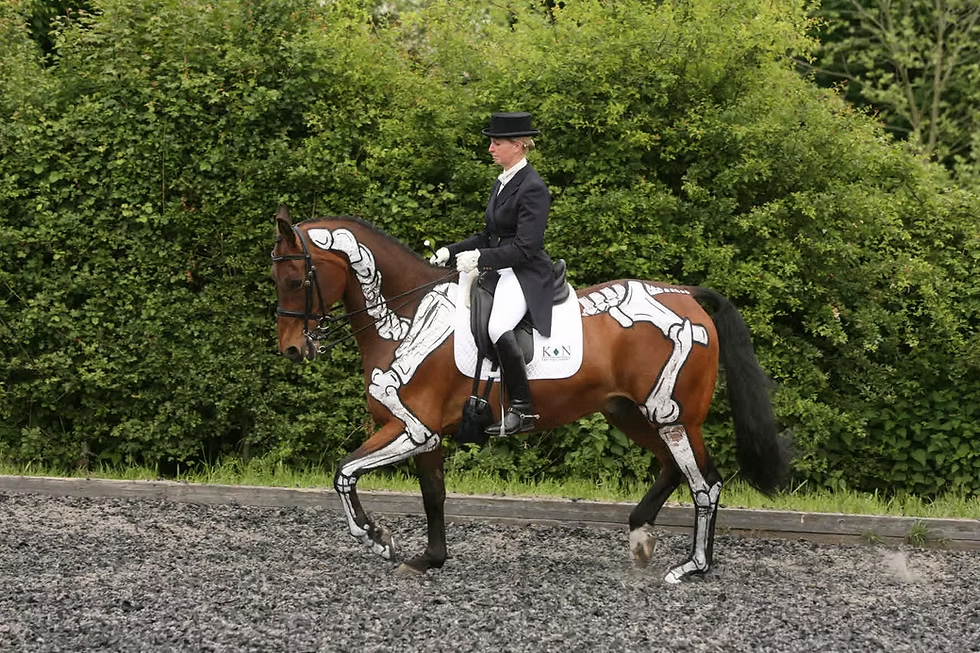
While the shoulder governs how forces are received, the hindquarters determine how they are produced. The croup, which reflects the angle and length of the pelvis, is critical for propulsion, engagement, and overall balance. A moderately sloped, adequately long pelvis allows the hind limbs to step well underneath the body and engage effectively. This alignment enables the large muscle groups of the hindquarters to generate power and carry a portion of the horse’s weight, particularly during collection or jumping efforts. When the hind end functions correctly, it shares the workload with the forehand, reducing cumulative stress on the front limbs.
A steep croup limits the range of motion at the hip, restricting the horse’s ability to engage and push. The hind legs tend to trail behind rather than stepping under the body, which shifts the burden of movement forward. As a result, the forelimbs absorb more impact and fatigue more quickly. Conversely, an excessively flat or short croup can also compromise function by limiting thrust and reducing the efficiency of power transmission.
In both cases, the problem is not simply a lack of performance—it is a redistribution of stress. When the hindquarters fail to contribute effectively, the forehand compensates, and this imbalance is a common precursor to front-end lameness. Many chronic forelimb issues can be traced back to insufficient engagement behind.
Bone-to-Tendon Ratio: Balancing Strength and Elasticity

The lower limb of the horse functions as a highly specialized spring system. Bone provides the structural framework to withstand load, while tendons and ligaments store and release elastic energy with each stride. The relationship between these components—often described as the bone-to-tendon ratio—is a critical factor in durability.
Horses with sufficient bone relative to their size and workload are better equipped to handle repetitive stress. Strong, flat bone and well-defined joints provide a stable base, allowing the tendons to function within a safe range of strain. This balance supports efficient energy recycling without overloading soft tissues.
When bone is too fine, however, the demands of performance are disproportionately placed on tendons and ligaments. These structures, while elastic, have limited tolerance for excessive or repeated strain. Horses with inadequate bone often demonstrate brilliance early in their careers but are more susceptible to tendon injuries, suspensory problems, and stress-related breakdown over time.
On the other end of the spectrum, excessively heavy bone can reduce efficiency, increasing the energy required for movement and limiting athletic expression. The most successful sport horses fall within a functional middle ground, combining enough structural strength to withstand load with sufficient elasticity to move efficiently.
The Integrated System: Movement as a Kinetic Chain
No single conformational trait operates in isolation. The horse moves as an interconnected system in which forces are generated in the hindquarters, transmitted through the back, and absorbed by the forehand. The distal limb then stores and releases energy, completing the cycle.
When each component is aligned and functioning correctly, the system distributes stress evenly. Movement appears effortless because no single structure is overloaded. However, when one element is compromised—whether it is an upright shoulder, an inefficient pelvis, or insufficient bone—the balance is disrupted. Other parts of the system compensate, often silently at first, until cumulative strain manifests as injury.
For this reason, conformation should always be evaluated in terms of how well the entire system works together, rather than focusing on isolated traits.
Final Perspective
In competition horses, conformation is ultimately about managing stress over time. While training, conditioning, and management all influence performance, they cannot override fundamental structural limitations. A horse with efficient biomechanics may withstand years of work with minimal injury, while one with conformational disadvantages may struggle to remain sound despite careful management.
Breed, discipline, and current fashion may influence what is considered desirable, but the principles of physics remain constant. Horses that combine a well-laid-back shoulder, a functional pelvis, and an appropriate balance of bone and soft tissue are better equipped to distribute forces efficiently. In doing so, they preserve not only performance, but longevity.
Understanding conformation in this way shifts the focus from appearance to function, allowing for more informed decisions in selection, training, and long-term care.


